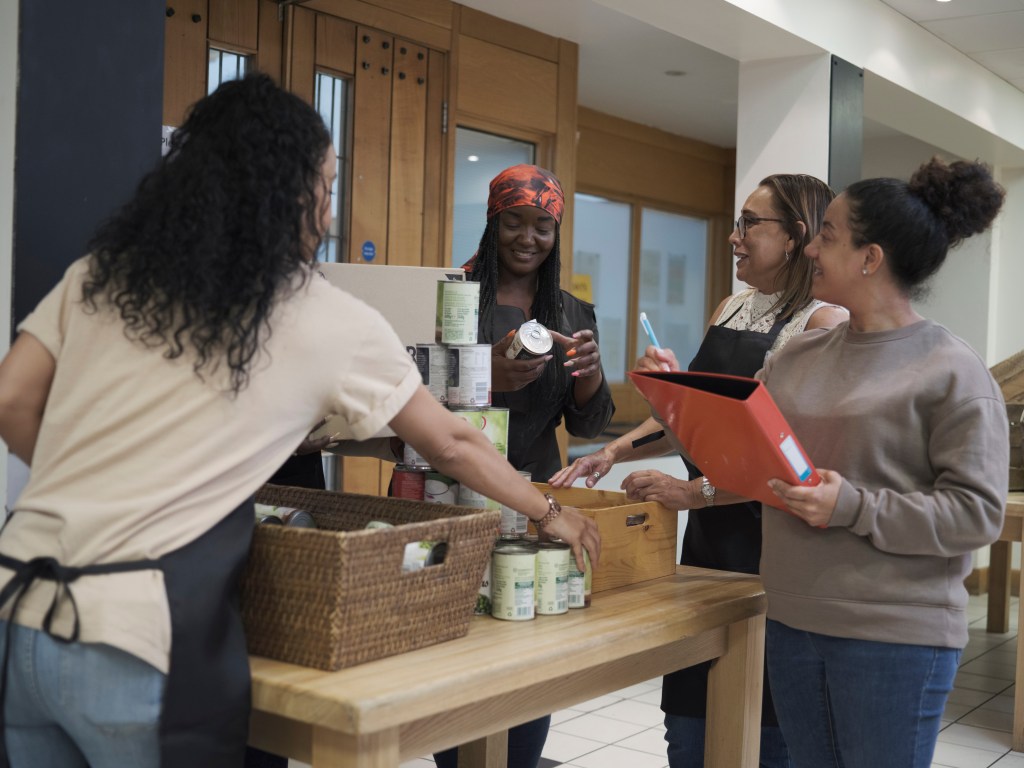
Fight Hunger with Local Food

The last food pantry that I worked at was always buried in local plums during summertime. Community members, overwhelmed by the abundance of their fruit trees, knew that we had the capacity and the enthusiasm to take as much as they had to give away. Our walk-in refrigerator was piled high with cases of fruit and coated in the sticky juice that rapidly spread to all surfaces of the pantry.

The scale of the donations and the short shelf-life of ripe plums meant that we encouraged our visitors to take as much as they wanted, no holds barred. Alongside this fruit, we also received donations of excess zucchini, cucumbers, tomatoes, root vegetables and more from local gardeners.

These foods were fresher than what we got from the grocery stores, and the irregular sizes, shapes, and colors were popular among our clients precisely because they identified the foods as locally grown.

But as summer ended and the local gardens and fruit trees were depleted, our fresh options dwindled as well. Our produce selection shrank to whatever we received from grocery stores and our regional food bank, rarely in the same quantities as the plums, and never as fresh.

While the term “local food” is thrown around often enough to numb us to its meaning, there are real, tangible reasons why it is important and worth supporting.

Alongside tasting better, fresh foods are more nutritious, and small local operations are far more likely to grow varieties that haven’t been sapped of their nutritional value.

Making local purchases ensures that money stays in the community, rather than heading to a corporation halfway around the world. Foods grown in our community travel shorter distances, which means they have less of environmental impact when it comes to transportation and storage.

I have to note that it’s important to consider what our definition of “local food” is. While contracts and federal funding demand more clarity, my favorite framing of local is food that comes from as close as possible. Only eating locally grown foods is largely unrealistic- there are no cocoa farms in Oregon, so I’m not willing to even try. However, focusing on foods grown in our region when we can adds offers real benefits to our bodies and our communities.

But food banks and pantries were not designed to prioritize fresh options, and the systems we have rarely support local producers or growers.

Where do food pantries get their fresh produce?

  • Donations from grocery stores. These donations are often where pantries find a real diversity of foods, based on the store’s options. However, they may vary widely in quality because all stores (and their staff) have different standards for how donations are handled. Some donate foods when they’re just past their peak but still functional, but often times donations are well past their use-by date. It’s not malicious- this is simply a system that doesn’t really work for fresh produce.

  • Food banks. These options can come from grocery stores, but also producers and distributors who may have over-ordered or are unable to sell the food for a variety of reasons beyond expiration dates. Food banks are generally able to access and store higher quantities of produce, which in turn helps food pantries offer more consistent choices for their shoppers. An increasing number of food banks have started buying produce in bulk, but generally must prioritize price over place of origin.
  • Community and neighborhood gardens. Some community gardens dedicate specific growing space for their local pantry, while others simply donate their excess. This often helps pantries access foods that grow in abundance, like zucchini, cucumber, tomatoes, and of course plums and other fruits. Getting these foods to the food pantry can sometimes be challenging, because there may not be enough volume to justify the organization doing regular pickups.

The challenge with all of these options is that most of the time fresh produce is donated because no one else wants it. While occasionally mistakes like over-ordering lead to accessing perfectly ripe produce, most donations are made because the food is past its peak or is otherwise undesirable.

Even the community garden donations tend to skew towards ten-pound zucchinis and bruised apples. While these options are still functional, these are not foods that food pantry clients would select at the grocery store or their local farmer’s market.

Offering foods near the end of their lifespan also shortens the timeline of when someone can use it. Providing produce that needs to be eaten immediately means that recipients will not have any fresh produce after just two or three days, and makes it harder to assemble tasty, functional meals.

How can anti-hunger organizations access quality local produce?

  • Purchase produce. Since the pandemic, more and more food banks have been purchasing produce to pass on to pantries that is more desirable and lasts longer. With thoughtful purchasing, we can support local farmers, reduces shipping costs, and offers fresher food to clients. It does require a shift in priorities to secure additional funding, so it demands leadership that is clear and committed to the mission of uplifting the health of their community.
  • Connect with farmers markets. One of my food pantries regularly received a donation of excess produce from the farmers market, and it was always magnificent! This food was far fresher than anything we ever got from the grocery store and provided a wider range of culturally specific options. However, one of the main challenges of this partnership is that farmers markets are often weekly events whose schedule may or may not align with food pantry hours.
  • CSA (Community Supported Agriculture). This week I connected with a food pantry that buys shares from their local CSA to supplement their fresh produce options, and I’m absolutely enamored with the idea. This is a brilliant way to support local farmers, access fresh produce, and maintain a diversity of options in the pantry. The primary challenge for using this is that CSA shares generally need to be picked up on site, but food pantries who already have volunteers doing donation pickups may be able to add another site to the schedule.

I checked in with my food justice friends to name a few of their favorite CSAs. While the season is winding down, you can still save this list for next spring!

Turkey River Farm in Elkport, IA

Old Homeplace Farm in Oneida, KY

Land’s Sake Farm in Weston, MA

Wild Coyote Farm in Berrien Springs, MI

Three Goats Farm in Oregon City, OR

Zenger Farm in Portland, OR

Old Plank Farm in Plymouth, WI

*There are other ways for people experiencing hunger to access local produce outside of the pantry- such as Double Up Food Bucks and Veggie Rx. Today I’m specifically examining how to get those foods into pantries.

The opinions expressed here are solely my own and do not express the views or opinions of my employer.

Want to learn more about food justice? Subscribe so you never miss a post!

Do Food Pantry Clients Have the Time to Cook From Scratch?

After a long day of work, there is nothing worse than having to decide what to cook for dinner. If I don’t already have a plan, figuring out how to quickly assemble a meal that is nutritious and appealing based on what’s in the fridge is a challenge. As a perpetually hungry (and often hangry) individual, I hate scrambling to put a meal together last minute.

While I’ve previously discussed the emotional labor of fighting hunger, it’s also important to acknowledge the emotional labor it takes to nourish a household.

Preparing meals for your family requires an enormous amount of thinking and planning, no matter how simple the actual process of cooking may be.

Preparing food isn’t limited to the physical labor of cooking.

Meal planning requires considering personal preferences, nutritional requirements, cooking skills and capacity, and the availability and accessibility of ingredients. The household cook must align household expectations with their budget and resources.

This work is largely invisible, and sharply divided by gender. For people who aren’t the primary cooks of their household (like the men who predominantly manage anti-hunger programs and determine policy), it’s easy to believe that meal prep only encompasses the tasks necessary to safely cook, prepare, and serve dinner.

The challenges of putting together a tasty meal are amplified if you’re a food pantry client, as you likely have little choice or autonomy over the foods and quantities available to you.

One of the primary challenges is that more than half of people facing food insecurity are employed full time. Those who aren’t working full time face significant barriers to doing so, such as disabilities, caregiving responsibilities, or a lack of employment opportunities. To make ends meet, many people work multiple jobs, which means available time for food preparation is extremely limited.

The next challenge is to figure out how to turn eight cans of beans, two cans of tuna, a butternut squash, and a jumbo bag of potato chips into something your household is excited to eat. While I’m sure it can be done, it takes creativity, research, and time to transform food pantry donations into a functional meal. This is a big ask from someone already overextended by the trials of poverty.

Despite the challenges of living with food insecurity, we still haven’t moved away from the unrealistic expectation that people who care about their families cook wholesome, time-intensive meals from scratch, and project that assumption on our emergency food assistance programs.

While we don’t have the option of increasing wages or reducing work hours for our clients, there are steps food pantries can take to ease the burden on our shoppers.

  • Provide foods that accommodate a variety of lifestyles and living situations. Too many of our food pantry clients had little time or capacity for intensive cooking sessions. While I applaud the movement to emphasize fresh, whole foods, this level of food prep may not be accessible for working households. Microwave meals, canned goods, and instant options are essential to accommodate all lifestyles. It’s important to remember that our opinions of what people “should eat” has no impact on what they are able to eat.
  • Bundle. The food that pantries provide is only useful if clients can use it. That means providing food in quantities and partnerships that make it useful. No one eats tomato sauce on its own- partnering it with pasta, chili ingredients, or other pairings ensures that it supports a functional meal. While providing a household with a small can of chicken noodle soup may prevent starvation, it doesn’t relieve the burden of trying to figure out what else the meal requires to make sure everyone’s belly is full. Offer useful quantities and partner with appropriate items when possible.
  • Offer culturally appropriate foods that are familiar to clients. This saves people from having to learn how to prep new foods and convince their family to eat it. (While I’m a fan of encouraging people to try new foods, it’s important to offer it as an option rather than expectation.) Offering cooking classes or taste tests alongside sensitivity training for volunteers may be necessary to ensure they are able to appropriately support clients when shopping.

The opinions expressed here are solely my own and do not express the views or opinions of my employer.

Want to learn more about food justice? Subscribe so you never miss a post!

What Data Should We Ask of Food Pantry Clients?

I once got a phone call at my food pantry from a woman who had recently tried to get help from another pantry in the region. Crying into the phone, she wanted to make a complaint about the volunteer she had worked with, mistaking our pantry as the parent organization.

This woman was trying to get food for the first time from this site but was told because she didn’t have proof of identification for every member of her household, she wasn’t eligible. She became understandably upset, and in the ensuing argument was told she was banned from visiting for a year. She was panicked that her family would go hungry, and frustrated by the excessive demands to qualify for food assistance.

Requiring proof of identification from every member of her household was an excessive and inappropriate expectation. Who carries that kind of information with them? How do they manage that with children in the household? I was frustrated that this happened, but requiring documentation or proof of need is a longstanding tradition in emergency food assistance. Our desire to make sure that people really “deserve” the help motivates demands for proof of income, address, or other evidence that proves a household struggles with hunger.

The more information organizations require of their clients, the more people they deter from participating.

If our goal is to reduce hunger, then this is antithetical to our mission. In many cases, merely the fear or stigma of having to prove one’s need is enough to stop many people from seeking help.

Most food pantries require their clients’ names, birthdays, address, and the names and birthdays of all household members. Sometimes this information is required to determine eligibility (like address for programs who only serve certain zip codes), while others simply need it for their records. Federal programs like TEFAP may also require an income declaration for proof of need.

 When I first started working at one of my food pantries, they required gender as well, for a completely unknown reason (as soon as possible I changed it to asking our shoppers’ pronouns instead.)

Requiring documentation represents an burden for many different reasons. Immigrants, regardless of their immigration status, may be fearful of authority and avoid situations that leave them vulnerable and subject to scrutiny. In addition, too many organizations do not or are unable to translate their documents and signage explaining their requirements, which makes them largely inaccessible to people who don’t read or write in English. Not knowing expectations can be immensely intimidating.

I have also worked with multiple survivors of domestic violence who refused to share even their names out of fear that their abuser might find them. The administrative requirements of food assistance should never outweigh the safety of the people we are trying to serve, but in many cases, this demands making exceptions to existing policy.

Documentation can also be a barrier for people who are houseless, or who don’t have easy access to the necessary paperwork. They may or may not have an ID, and might not carry any other information with them. I’ve also worked with many young adults who were covertly trying to improve their family’s food supply and were therefore unable to access the information they need to get food.

Requiring documentation also increases the responsibilities of staff and volunteers to appropriately manage the information. TEFAP forms must be stored for years, while other intake documents must also be processed and stored while respecting the confidential nature of their contents.

But shortcuts can be equally problematic.

I recently connected with a food pantry that based eligibility on preexisting participation with federal programs like SNAP, WIC, and Social Security. Although it saved them from having to evaluate any other data, it also meant that a) their pantry was deliberately unavailable to populations that couldn’t access federal services and b) implies a greater government connection than often exists, which can be problematic for people fearful of authority or concerned with confidentiality.

How food pantries can be thoughtful about data expectations:

  • Minimize your eligibility requirements and ask for as little information as possible. What information do you really need and why do you need it (for partner reports, grants? Do these partners really need it, or are there alternatives you can offer?)
  • It can be tempting to make your client paperwork look as official and legitimate as possible. But this can increase client fears that their information is being collected by the government or other agencies outside of your organization. Developing less formal-looking paperwork can help.
  • Reassuring clients that we recognize the burden and annoyance of completing any paperwork helps minimize its importance and made it less intimidating. My previous food pantry participated in TEFAP, which meant there was one form that clients had to complete annually (or provide a signature at each visit). The speech my team gave was, “I know this looks super official and scary, but we promise that no one will ever look at this form and it will disappear in a dusty office drawer until we shred it.” This introduction opened up an opportunity to have a comfortable conversation about what we did with the information we collected, and how it was kept confidential.

Eligibility requirements persist in response to the fear that welfare abuse can be prevented through strict oversight and evaluation.

Adding documentation requirements limits service to shoppers who adhere to YOUR version of need. Who is excluded?

After a decade of working in food pantries, I can say with confidence that no one is trying to exploit food assistance. Every step we take to make services more accessible is progress towards ending hunger.

The opinions expressed here are solely my own and do not express the views or opinions of my employer.

Want to learn more about food justice? Subscribe so you never miss a post!

How SNAP Solves Hunger Better Than Food Pantries

Ending hunger is a big goal. I believe it can be done, but it’s important to acknowledge that it can’t be done through food pantries. As much as I love this model, food pantries have very little capacity to influence the systemic roots of hunger. They are merely a band-aid for a much bigger wound.

For the general public, the inadequacy of food banks and pantries to solve hunger may not be obvious.

Hunger is a symptom of oppression. People experience hunger because they have less access to money than others.

Even in the most isolated, famine-stricken deserts, there are people who have money to buy food and those who don’t. Fundamentally, hunger is a money shortage problem- not a food problem.

People who struggle to afford food have jobs that don’t pay living wages, can’t find safe and accessible housing within that low budget, can’t afford the medical care they need to stay healthy, face discrimination in employment or housing, or a host of other barriers that prevents them from being able to afford basic necessities.

The scope of need is far beyond what our food banking system can support. Over forty-four million Americans, or one in eight households, are food insecure.

It’s far more efficient to supply families with the money they need to buy their own food than to give them food.

A 2022 Feeding America study identified approximately 60,000 partner organizations including pantries and meals sights fighting hunger across the country serving more than fifty-three million households. This is a higher number than the one listed above because estimating food insecurity rates is complicated and often undercounts the reality.

If the work was evenly distributed between these organizations, each partner agency would serve 883 households, which is far beyond the capacity of most organizations. With few food banks or pantries able to meet the full nutritional needs of their clients, it’s obvious that meeting the needs of nearly nine hundred households is an impossible and utterly unrealistic goal.  

Beyond this, emergency food assistance programs are not equally accessible. Pantries are rarely open more than one or two times a week, with many only offering a few hours once per month to serve a couple dozen clients.

Food pantries are often open during the hours most convenient for volunteers and staff, which are likely the opposite of accessible hours for working individuals or those juggling caregiving responsibilities.

Food banks and pantries also tend to prioritize urban areas, which makes them much less accessible to rural residents who are more vulnerable to hunger. Organizations congregate near their food sources rather than their clients, which leaves them as inaccessible as the grocery stores that households experiencing hunger can’t get to.

Food pantries are predominantly run by people of Western European backgrounds, which means they may not have the interest, knowledge, or capacity to serve culturally appropriate foods for their clients.

In comparison, as an entitlement program, anyone who qualifies for SNAP (formerly known as Food Stamps) can use it, which means there is no limit on the number of households served, unlike food pantries. This program can support the level of need (if politicians are willing to fund it).

SNAP provides money specifically allocated for food via Electronic Balance Transfer (EBT) which allows people to shop discreetly by paying with a card.

Although SNAP can only be spent at participating retailers, the number of stores accepting SNAP far outweighs the number of food pantries. Additionally, grocery stores have wider hours that can accommodate families working long or flexible shifts.

The most valuable aspect of SNAP is that it allows autonomy of food choice.

Although still limited by the funds available, users get to make their food purchases based on what their family wants or needs, rather than the much more limited and restrictive options that food pantries provide.

While SNAP users still experience harassment for being food insecure, there is less humiliation and judgement in shopping at a grocery store than in using a food pantry.

SNAP is one of the best anti-hunger tools we have. It’s important to recognize the urgency to shift the burden of fighting hunger from food pantries to SNAP and other federal programs if we’re actually committed to solving this problem.

How can food pantries uplift SNAP?

  • Help sign clients up for SNAP! As a government program, the application process can be intimidating, confusing, and wrought with complications. Making sure everyone has the support to participate is huge- too many people who are eligible don’t even apply.
  • Educate our communities on the complex relationship between housing, healthcare, wages, and hunger. Money is more effective than donated and expired food, and increasing SNAP benefits is our best tool against hunger.
  • Help clients sign up for SNAP! This is so important it deserves to be said twice. Food banks and pantries can’t end hunger, and SNAP is our strongest opportunity for relieving the burden on this industry.

The opinions expressed here are solely my own and do not express the views or opinions of my employer.

Want to learn more about food justice? Subscribe so you never miss a post!