
Why Kindness Doesn’t Fight Hunger

A media source once visited one of my food pantries and requested interviews with some of our shoppers. My favorite moment was when a client told the interviewer with great enthusiasm, “They’re not just nice to me- they’re nice to EVERYONE!”

This resonated because I regularly heard stories about the experience our clients had at other food pantries- and kindness seemed in short supply. In most cases it was not that volunteers or staff at other organizations were explicitly rude- it was that those seeking emergency food assistance are sensitive to judgement, disingenuity, and prejudice. There is already such stigma against using emergency food assistance internalized by both recipients and distributors, that without conscious effort, it’s easy to commit microaggressions even while acting kind and welcoming.

No one wants to go to the food pantry.

I have never met someone who preferred to be handed discarded, cast-off, or expired food at a food pantry over having autonomy over their own grocery shopping.

Of course, many people are grateful for the much-needed help in feeding their families, but even the most dignified food pantry experience isn’t better than the power to choose what and how much your family wants to eat without restriction. (And of course, no one needs to be grateful for food.)

This reality influences every food pantry visit. Recognizing that no one wants to be there, it’s essential for organizations to ensure that they’re sensitive to the baggage that accompanies such a task.

While institutional policies impact the food pantry experience, volunteer attitudes and actions carry the greatest weight when it comes to building a safe space for people experiencing hunger. Having volunteers truly committed to compassion, kindness, and empathy is the most effective way to establish a dignified food pantry environment but is no simple achievement.

Even when volunteers are kind and welcoming, it can be easy to unconsciously reflect problematic attitudes through their actions. By building respectful foundational attitudes, you can help your volunteers practice empathy at every shift.

Assume good intentions.
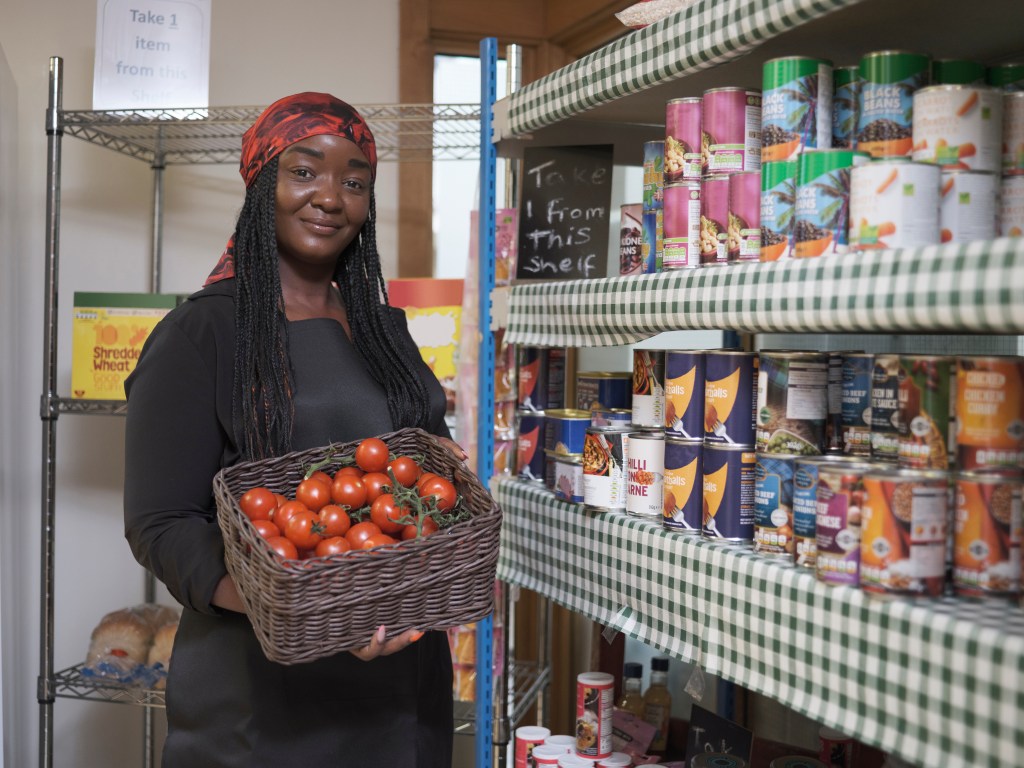
Remind volunteers that we never know the whole story of why someone is at the food pantry- and it’s none of our business. If your community embraces the idea that people only come who are in need, then it’s easy to make everyone feel welcome without judgement. If volunteers (or staff) think people are there to exploit the system, this reflects in conversations, actions, and policy. Any concerns voiced should be an opportunity for discussing barriers to food security and building respect.

A client arriving in a fancy car may have recently experienced a catastrophic job loss or medical bill that leaves them broke, even though their car screams wealth. Expensive belongings may have been donated, or speak to previous stability, or maybe were all that was grabbed while fleeing domestic violence.

Remembering to be open-minded about the circumstances that bring someone to the food pantry creates a space free of judgement, which will help visitors feel more welcome. Volunteers who can’t adopt this mindset may need to find a different opportunity.

Food is a gift.

Just like any other gift given, the giver has no authority over how it is used. With all the work that goes in to sourcing and distributing food for emergency services, it’s easy to feel possessive over how it’s used. But if we maintain the assumption that everyone who visits a food pantry does so out of need, we need to relinquish the compulsion to control how the food is used.

We’re still building food security if the food is shared with a neighbor, or served at a church luncheon, or stashed in the back of a cupboard untouched for a future emergency. For pantries that are without limits, this attitude can also help check judgements about how much people take. Once it’s in someone’s cart, we can appreciate the hard work we put in to get it there and celebrate that someone will eat well tonight. It doesn’t matter who, or what, or how much.

Services are for shoppers.

I once had a week-long argument with a coworker who was adamant that our food pantry was a volunteer-centered organization. They argued that clients were the vehicle we used to provide an experience for our volunteers, which justified turning away any client who negatively influenced this experience.

The fact that services should focus on fighting hunger seems obvious, but all direct-service anti-hunger organizations wrestle with this conundrum every day. An explicit commitment to serving the community needs to be regularly revisited to ensure that policies focus on the needs of shoppers. This doesn’t mean that volunteers or staff are neglected, but their needs should be considered in a different light.


Everyone knows the importance of being kind at a food pantry, but establishing an atmosphere that truly welcomes people without judgement or stigma requires a much stronger foundation. While established a clear mission and supporting policies can help, this is also the kind of foundation that can be built guerilla-style by a single individual ready to make a change. Conversations uplifting each of these tenets can slowly permeate the organizational culture and build an environment that is more genuine and welcoming, and therefore more effective at fighting hunger.

The opinions expressed here are solely my own and do not express the views or opinions of my employer.

Want to learn more about food justice? Subscribe so you never miss a post!

Fight Hunger with Fair Wages for Womxn

It’s counterintuitive, but the most effective anti-hunger programs rarely prioritize food. Instead, they focus on poverty alleviation.  Policies that don’t directly fight hunger, like paid maternity leave, paid sick time, and affordable childcare, are some of the most important opportunities we have for ending food insecurity. 

However, we are failing to address a major economic rift between Americans that continues to plague families and individuals regardless of social or wealth status: the gender wage gap.

This March ‘24, Senior Economist Elise Gould at the Economic Policy Institute had the dubious honor of reminding us of the little that has been accomplished in the last 30 years to improve the earning power disparity between genders

It’s hard to see this report, to be reminded that despite how hard I work, as an American womxn I can expect to make at least 16% less income than my male counterparts, worse yet as I chose a career in non-profit.   

At the risk of triggering any “TERFs” reading my content, I advocate broadening the gender pay gap argument to include womxn, to be inclusive of trans and gender nonconforming individuals, people of all racial backgrounds, and anyone else who identifies under this umbrella. Compensation and discrimination are core to food insecurity for all marginalized communities, but today I’m examining how this relates to gender.

It’s essential to recognize that all womxn, no matter their individual identity or situation, face discrimination with serious financial implications that impacts their food security.

Disparities in compensation increase for people of color, LBGTQ+, and those with disabilities. We can’t effectively fight hunger without calling out these stark truths.

Gould’s report for the EPI reminds us that not only are womxn unable to capture as great a proportion of what society reaps, but they are also disproportionately impacted by economic shocks and the impacts of poverty.  In a challenging job market with rising inflation, the loss of sixteen cents or more per dollar adds up to an impactful shortage. For many womxn, this is the difference between food security and not knowing where their next meal is coming from.

Because womxn are predominantly the caregivers, cooks, and shoppers of a household, they are often presented as the face of food insecurity, but focusing on the experience makes it easier to ignore the root causes.

Paying womxn less money than men is a primary cause of food insecurity.

In the role of caregiver, womxn are often forced to choose jobs that offer flexibility to accommodate the needs of their family, which generally pay lower wages. In addition, workplaces deliberately pay mothers less money than womxn without children.

Lower expectations of caregiving and blatant shows of sexism offer men more flexibility to pursue jobs with higher wages, and even reward them for having families

Our cultural consciousness often assumes that people experiencing hunger, especially those who are employed, just need to work harder or find a better-paying job to enjoy success.

As a society that proudly embraces the idea of “pulling yourself up by your bootstraps,” identifying a lack of effort as the primary cause of poverty is a comfortable explanation that demands no collective action.

But this justification weakens once you take a closer look at the demographics of hunger. Out of all the people experiencing food insecurity globally, 60% are women (data is a little murkier for womxn, but it’s safe to assume the number only goes up). Numbers are similar nationally. There’s no rational argument that womxn just need to work harder.

Gould’s EPI report ends with a reminder despite little narrowing of the gap in the last thirty years, programs like universal healthcare, affordable or free childcare, and paid leave are proven to make an enormous difference in how women are able to allocate their disproportionately low wages. Although I’m passionate about changing our approach to hunger primarily within the field, it’s important to recognize that we can’t make impactful change until we eliminate the gender compensation gap.

Major thanks to Kern Herron for his significant contributions to this piece.

The opinions expressed here are solely my own and do not express the views or opinions of my employer.

Want to learn more about food justice? Subscribe so you never miss a post!

Want Food Assistance? Go Broke First

If someone is experiencing hunger, they must be completely broke, right?

The idea that people seeking emergency food assistance have no money is a perspective I regularly encounter in the world of food banking and social services and amongst the public. If you have any money at all, society deems you undeserving of food assistance.  

Fueled by a collective conviction that people experiencing hunger aspire to exploit the system, anti-hunger policies reinforce assumptions with restrictions that prevent us from effectively fighting hunger.

Emergency food assistance resources such as the Supplemental Nutrition Assistance Program (SNAP) and The Emergency Food Assistance Program (TEFAP) require participants to declare income and financial assets below a certain threshold determined by federal and state policies.

Benefits are reduced or halted when recipients exceed these limitations, intending to prevent people from taking advantage of resources they don’t need, assuming they should deplete their own resources first. These policies perpetuate the idea that people must be completely broke to deserve food assistance. (Most states have implemented a policy workaround to these limitations called Broad-Based Categorical Eligibility, but the paradigm in favor of restrictions remains.)

A serious consequence of setting limits is that it prevents individuals living in poverty from preparing for financial emergencies. As studies repeatedly demonstrate, most Americans do not have the resources to weather an unexpected $1,000 expense without hardship.

All it takes is one unforeseen medical bill, car accident, or housing transition to deplete one’s savings. Limitations on assets ensure that families who have the capacity to save a little every month are disincentivized from doing so, because it’s unlikely that savings can sustain them as effectively as SNAP or TEFAP.

For those who have the capacity to save, the federal asset limit for SNAP is $2,750, beyond which a household may lose their food assistance. It is usually far safer in the short term for a household struggling with food security to stop building savings than to relinquish SNAP benefits.

Some of my readers may react with disgust at the idea that an individual can have nearly $3,000 and still receive food assistance. That seems like far too much money to need help. Most Americans have far less.

Our society believes that people must be utterly broke, without a penny to their name, to deserve social assistance. We demand that they deplete their own resources before utilizing any others. But this is an incredibly destructive attitude that perpetuates hunger.

Fears of abuse are internalized by the people receiving assistance as well as those implementing it.

At my food pantry, I used to regularly encounter first-time clients who confessed that their cupboards were empty, or that they hadn’t eaten that day, or had been subsisting on a single daily meal. “I didn’t want to take resources away from someone who needed it more” was a constant rationalization for postponing seeking help.

When we require that people are empty before we fill them up, we deliberately increase their barriers to achieving stability and security.

It also breeds a perverse sense of competition. If there is always someone hungrier than you out there, do you ever really deserve help?

Demanding that people living in poverty burn through their savings before receiving SNAP or shopping at a food pantry leaves them in a vulnerable position, while providing our neighbors with abundant and dignified food resources before they spend their last dollar is far more likely to ensure that they remain food secure, housed, and healthy.

The opinions expressed here are solely my own and do not express the views or opinions of my employer.

Want to learn more about food justice? Subscribe so you never miss a post!

You Can’t Solve Hunger With Grocery Stores

In 2011, I moved from Oregon to a rural, isolated region in eastern Montana. My AmeriCorps position was tasked with helping build a school garden in a neighboring town and to explore the possibility of developing a cooperatively run grocery store in the community next door. Both these tiny towns had high poverty and hunger rates, but the one lacking a grocery store faced some serious challenges. With less than three hundred aging residents, this community was approximately thirty miles from the nearest small grocery store, and eighty miles from a department store. My workplan proposed assessing the feasibility of bringing a grocery store to this “food desert.”

At the time, eliminating food deserts was a trending solution for fighting hunger. Spurred on by Michelle Obama’s healthy food initiatives, the movement assumed that distance was a primary barrier to healthy foods for these communities. Her campaign advocated for bringing grocery stores and retailers of fresh produce to communities experiencing hunger to facilitate access and consumption of healthy foods, to the benefit of children and communities alike.

Over the past decade, we’ve learned that hunger in low access communities is far more complex than simply being able to get to a grocery store. Although physical access is an important barrier to consider, it is not necessarily the one most significantly influencing hunger rates.

Although still in occasional use, the phrase “food desert” has fallen out of favor, and for good reason.

The term itself is misleading. The official definition of a food desert is a region that is more than one mile from a grocery store in an urban setting or more than ten miles in a rural area. Rather than recognizing the assets available, the phrase defines a community based on what it lacks. A desert conjures up an image of a desolate wasteland, bereft of resources. This paradigm disempowers communities by ignoring the power and resources they do have, and glossing over the fact that what they lack is determined by external influences.

Another reason the term is no longer regularly used is because it recognizes that a desert is a naturally occurring ecosystem, whereas a food desert is a deliberately manufactured setting.

Choices are made at every level of administration and government to determine whether a region gets a grocery store, or a farmers’ market, or nothing but fast-food restaurants. The creation of a food desert is anything but passive, and it’s rarely a decision that residents have influence over.   

In the 1980s, activist Karen Washington introduced the term “food apartheid” to describe communities lacking adequate food access more accurately. It references the racial disparities of hunger highlighted by redlining, segregation, and discrimination.

Over the last ten years, the food justice community has improved our appreciation of terminology which explicitly recognizes that hunger and poverty is never an accident. Too much of our society’s understanding of food access focuses on individual responsibility, but adopting language that uplifts the systemic nature of hunger is an essential step to helping evolve our cultural paradigm. Calling out apartheid is a powerful and impactful way to engage with the systemic nature of hunger.

In the Montana community where I worked, surveys revealed that most residents wouldn’t shop at a store in town unless its prices were cheaper than those of the major retail chain eighty miles away. Residents recognized that the prices for a local grocery store, no matter how well managed, would never be as low as the supercenter even considering the price of fuel to get there, and they simply couldn’t afford it.

Introducing a local store would have had minimal to no impact on residents.

This explicitly demonstrated that income and cost were the greatest barriers to food security for this small town. Calling it a food desert oversimplified these challenges, and ignores the fact that poverty prevented people from shopping or eating how they like. Montana’s high population of Indigenous People, and economic forces that produce the ultra-cheap, exploitive, centralized supercenter grocery model, absence of living wages or healthy retirement accounts, ensured that this town remained food insecure.

Calling it a food desert prompts solutions that bring resources to the area that don’t empower residents, while confronting food apartheid makes us address the reality that hunger can’t be solved without systemic change.

The opinions expressed here are solely my own and do not express the views or opinions of my employer.

Want to learn more about food justice? Subscribe so you never miss a post!